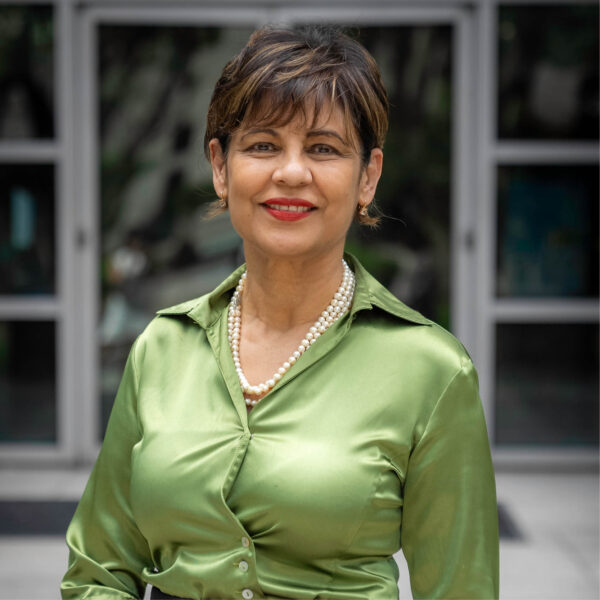
Imrana Jalal
Special Project Facilitator,
Office of the Special
Project Facilitator
Imrana Jalal
Special Project Facilitator, Office of the Special Project Facilitator

Elisea Gozun
Chair, Compliance Review Panel
Elisea Gozun
Chair, Compliance Review Panel
Over time, we, in the AM offices, have learned the importance of standing in the shoes of people affected by ADB-assisted projects to resolve their problems. Through our work, we can connect affected people, especially the most vulnerable, with the decision makers, be they the borrower or ADB Board.
This annual report marks a significant chapter in our commitment to fostering connections, understanding, and trust among various stakeholders involved in ADB-assisted projects.
Our primary focus has been on empowering the voices of affected people and communities, and building trust between them, the borrower, and ADB.
By nurturing these connections, we aim to cultivate a foundation of trust, understanding, and collaboration that is fundamental to the success of our shared endeavors. Strengthening relationships is not merely a goal but a commitment to creating a harmonious ecosystem where the interests of all stakeholders are acknowledged and addressed.
This year, we intensified our efforts to make connections within our own organization and beyond. Through targeted outreach and learning sessions, we strived to enhance connections between the AM, ADB Staff, executing agencies, implementing agencies, civil society organizations (CSOs) and nongovernment organizations (NGOs), and the affected people themselves. These interactions serve as vital threads that weave together a more cohesive and informed accountability framework.
Our outreach programs continue to serve as a vehicle through which we can impart the lessons learned from the cases we handled so that succeeding projects can be designed better, implemented more effectively, and monitored more successfully. We had joint learning sessions with ADB Staff and executing and implementing agencies in Fiji, Papua New Guinea, Samoa, and Tonga. We also had targeted sessions with CSOs in these Pacific Island countries, including the Cook Islands and Niue, and in the Philippines, where technical barriers to accessing the AM were also explored. The Office of the Compliance Review Panel (OCRP) had similar learning and awareness-raising sessions in Mongolia.
To extend beyond our immediate sphere, we participated in the pilot Massive Open Online Seminar, undertaken jointly with other Independent Accountability Mechanisms (IAMs) to reach more stakeholders through social media platforms such as YouTube and Zoom. In addition to the mandate and functions of the IAMs, the Massive Open Online Seminar also reinforced how typical dispute resolution and compliance review processes work and then reiterated that IAMs have a zero-tolerance policy on retaliation. By participating in working groups and annual meetings of the IAM Network, we are reinforcing bridges and fortifying relationships with our counterparts as we highlight our shared commitment to continuous improvement and learning.
Participating in the Annual Conference of the International Association of Impact Assessment provided us with a unique platform to share key lessons learned. This seminar part of the conference was a collaborative effort, which was organized by five IAMs. It emphasized the value of shared insights and collective wisdom to understand the top five issues raised by complainants to the AM and how best to avoid them.
As we go forward, we are mindful that 41% of our complainants during the past 12 years have requested confidentiality, with some specifically citing the risk of retaliation. We are thus updating and improving our Risk of Retaliation Guide and developing a toolkit based on international best practices to equip ourselves to handle such situations effectively. We want to ensure that affected people feel confident that they can raise complaints with ADB’s AM and that it will be handled properly without increasing the risk of retaliation.
In 2023, we witnessed a slight increase in complaints relating to the AM, surpassing any other year since the adoption of the AM Policy in 2003.
This may signify a greater openness among project-affected people to express their grievances. It may also indicate the heightened visibility of the AM. This may have been fueled by better outreach, active facilitation by CSOs and NGOs, and a growing confidence among complainants that their concerns can be effectively addressed. More complaints being lodged with the AM may also be a signal of increased trust and confidence in our two offices.
This Annual Report is a testament to our ongoing commitment to building bridges and strengthening relationships with, and among, different stakeholders. As we navigate the complex landscape of accountability and transparency, we embrace the challenges and opportunities that lie ahead, united in our mission to create positive and lasting impacts through our collective efforts.
We extend our gratitude to all stakeholders, including complainants, project teams, CSOs, and government partners, for their valuable contributions to the AM’s work. Together, we can build a more accountable and inclusive development process for the benefit of all.